
IIoT Trend #7: AI-Powered Cobots and AMRs Redefine the Factory Floor
Collaborative robots and autonomous mobile robots are scaling from isolated tasks to integrated factory-wide systems. In 2026, AI gives them the intelligence to adapt, learn, and work alongside humans safely.
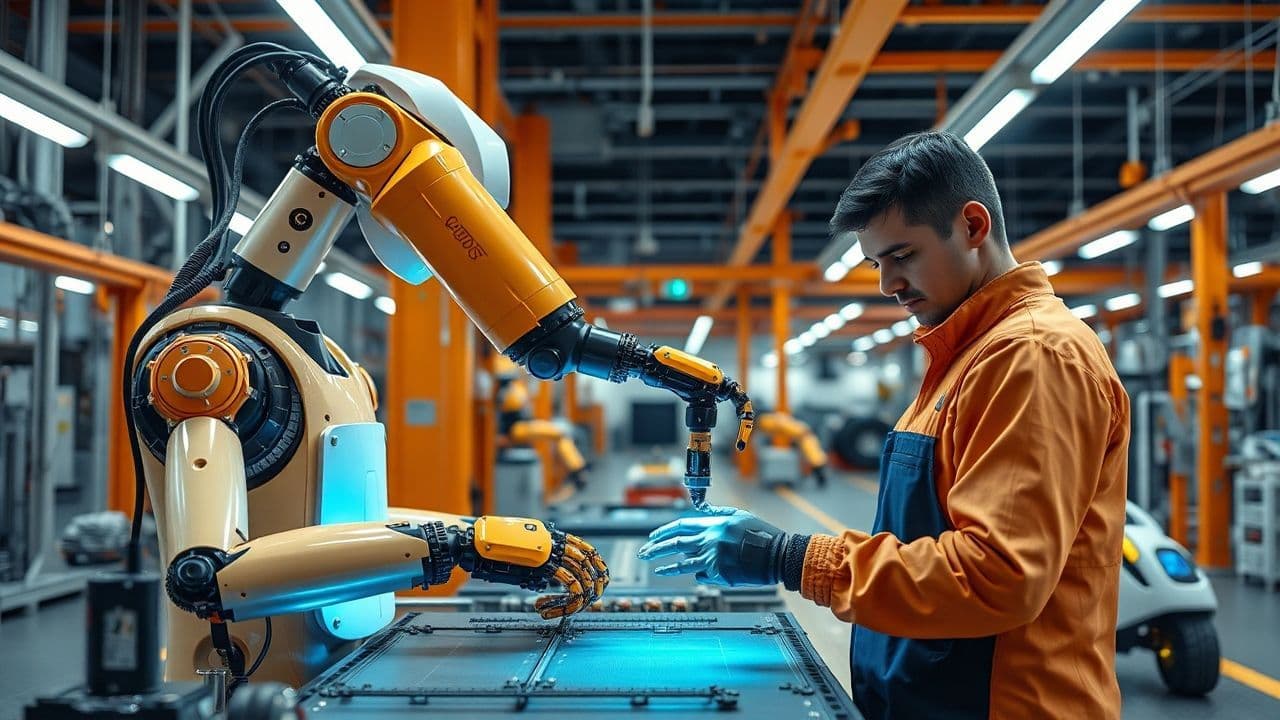
IIoT Trend #7: AI-Powered Cobots and AMRs Redefine the Factory Floor
Factories worldwide installed 542,076 industrial robots in 2024 - a historic level that has doubled over the past decade. In 2026, the convergence of AI, computer vision, and IIoT connectivity is transforming robots from rigid, pre-programmed machines into adaptive, collaborative systems.
Cobots Scale to Industrial-Grade Performance
A major trend for 2026 is the shift of collaborative robots (cobots) from light-duty applications to full industrial-grade performance. Today's cobots offer:
- Industrial durability and precision - handling tasks that previously required traditional industrial robots
- Generative AI integration - enabling cobots to move beyond pre-defined programming toward autonomous learning and multi-task execution
- 3D AI vision and force sensing - allowing real-time adaptation to changing workpieces and environments
- Natural language interfaces - operators can instruct cobots conversationally rather than through code
AMRs Replace AGVs
Autonomous mobile robots (AMRs) are rapidly replacing traditional automated guided vehicles (AGVs) due to their greater flexibility and lower upfront cost. Unlike AGVs that follow fixed paths (wires, magnets, or tape), AMRs use LIDAR, cameras, and AI to navigate dynamically around obstacles and people.
The global AMR market is projected to surpass USD 8.7 billion by 2030.
2026 Use Case: Autonomous Mobile Manipulators
An electronics manufacturer deploys Autonomous Mobile Manipulator Robots (AMMRs) - combining a cobot arm with a mobile AMR platform. These systems:
- Navigate autonomously between CNC machines to load/unload parts
- Use 3D vision to identify and pick components from unstructured bins
- Adapt their grip force based on part material and weight
- Communicate with the MES via MQTT to receive real-time production orders
The AMMR fleet operates 24/7 on a lights-out shift, handling 80% of the material movement that previously required manual labour. Human workers focus on complex assembly, quality decisions, and process improvement.
Key Challenges
| Challenge | Detail |
|---|---|
| High CapEx | Industrial cobots and AMR fleets require significant upfront investment |
| Safety certification | Collaborative robot deployments require risk assessments per ISO/TS 15066 |
| Legacy integration | Connecting robots to existing MES, ERP, and SCADA systems requires middleware and protocol translation |
| Change management | Workers may fear job displacement; successful deployments invest in upskilling and clear communication |
| Fleet orchestration | Managing dozens of AMRs in a shared space requires sophisticated traffic management and conflict resolution |
The Road to Industry 5.0
Future trends emphasise cognitive adaptability and human-centric automation. By 2030, cobots will understand context, anticipate issues, and adapt like human co-workers - aligned with the Industry 5.0 vision of technology serving people, not replacing them.
What This Means for Your Factory
Start with a defined, repeatable task - machine tending, palletising, or point-to-point material transport. Modern cobots can be deployed in days, not months. The key is to choose a use case with clear ROI and minimal disruption, then expand once the team gains confidence.
Sources: