
Digital Twins in Manufacturing: Your Factory's Virtual Mirror
Discover how digital twins create virtual replicas of your factory equipment and processes. Learn practical use cases, implementation costs, and how to get started with digital twin technology.
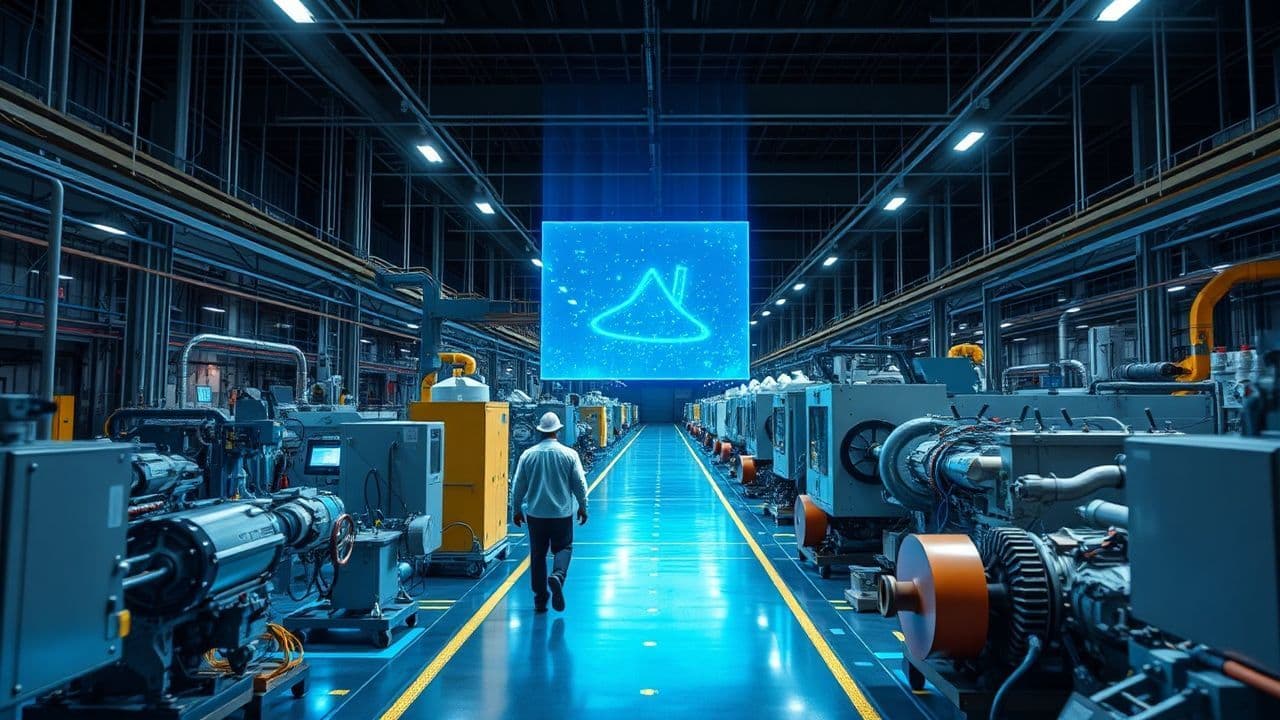
Digital Twins in Manufacturing: Your Factory's Virtual Mirror
Imagine being able to test a change to your production line without touching a single machine. Or predicting exactly when a motor will fail - not approximately, but within days. That's the promise of digital twins, and it's already a reality in factories around the world.
What is a Digital Twin?
A digital twin is a virtual replica of a physical asset, process, or system that is continuously updated with real-time data. It's not just a 3D model or a simulation - it's a living, breathing digital version of something real.
What Makes a Digital Twin Different from a Simulation?
A simulation is a one-time model. You set up parameters, run it, and get results. It's a snapshot.
A digital twin is continuously connected to its physical counterpart. As the real machine operates, the digital twin updates in real time. It ages, degrades, and behaves exactly like the real thing - because it's learning from the real thing.
| Feature | Simulation | Digital Twin |
|---|---|---|
| Data connection | Static inputs | Live, real-time data feed |
| Updates | Manual | Automatic and continuous |
| Accuracy over time | Decreases | Increases (learns from reality) |
| Use case | Design and planning | Entire lifecycle |
| Cost | Lower (one-time) | Higher (ongoing infrastructure) |
Types of Digital Twins in Manufacturing
1. Component Twin
A digital replica of a single part or component.
Example: A digital twin of a spindle bearing on a CNC machine that tracks vibration, temperature, and load to predict remaining useful life.
Value: Precision maintenance scheduling for critical components.
2. Asset Twin
A digital replica of an entire machine or piece of equipment.
Example: A complete digital twin of a robotic welding cell - including the robot, positioner, welding power supply, and fixturing - that mirrors the real cell's behaviour in real time.
Value: Optimise machine settings, predict failures, test new programs virtually.
3. Process Twin
A digital replica of an entire production process or line.
Example: A digital twin of your paint shop that models the flow of parts through pre-treatment, coating, curing, and inspection - including queue times, energy usage, and quality outcomes.
Value: Identify bottlenecks, optimise throughput, test process changes safely.
4. System Twin (Factory Twin)
A digital replica of the entire facility.
Example: A complete factory twin that models material flow, equipment status, workforce allocation, energy consumption, and production scheduling across the whole site.
Value: Strategic decision making, layout optimisation, capacity planning.
Real Use Cases That Deliver ROI
Use Case 1: Predictive Maintenance on Steroids
Traditional predictive maintenance uses sensor thresholds: "If vibration exceeds X, schedule maintenance."
Digital twin-enhanced maintenance goes further:
- The twin simulates the machine's degradation based on actual operating conditions
- It considers load profiles, environmental factors, and maintenance history
- It predicts remaining useful life with far greater accuracy
- It recommends the optimal maintenance window considering production schedules
Real result: A heavy equipment manufacturer reduced unplanned downtime by 70% and extended component life by 20% using digital twins for their machining centres.
Use Case 2: Production Optimisation
A food manufacturer created a process twin of their packaging line:
- Modelled every machine, conveyor, and buffer in the line
- Fed real-time data from sensors on each piece of equipment
- Simulated different production sequences and changeover strategies
- Identified that reordering their product sequence could increase throughput by 12%
Result: 12% throughput increase with zero capital investment - just a scheduling change validated by the digital twin.
Use Case 3: New Product Introduction
An electronics manufacturer uses asset twins of their SMT (surface mount technology) lines:
- Before running a new circuit board design, they simulate it on the digital twin
- The twin predicts placement accuracy, cycle time, and potential defects
- Engineers optimise the program virtually before the first real board is made
- First-pass yield improved from 94% to 99.2%
Result: Reduced new product introduction time by 40% and virtually eliminated first-run scrap.
Use Case 4: Energy Optimisation
A steel manufacturer created a process twin of their furnace operations:
- Modelled heat transfer, combustion, and material flow
- Compared actual energy use against the twin's calculated optimal
- Identified that burner tuning and charge sequencing could reduce gas consumption
- Implemented changes and validated results against the twin's predictions
Result: 8% reduction in energy costs, saving over $2 million annually.
Use Case 5: Operator Training
A chemical plant uses a system twin for operator training:
- New operators practice on the digital twin before touching real equipment
- They experience simulated emergency scenarios safely
- The twin responds exactly like the real plant would
- Training time reduced and safety incident rate dropped
Result: 50% faster operator certification, 35% fewer safety incidents in the first year of employment.
The Technology Stack Behind Digital Twins
Data Layer (Foundation)
You need reliable data flowing from the physical world:
- IIoT sensors - Vibration, temperature, pressure, flow, power, position
- PLC/SCADA data - Machine states, cycle times, set points, alarms
- Quality data - Inspection results, SPC measurements, defect records
- MES/ERP data - Production orders, schedules, material consumption
Modelling Layer (The Brain)
Software that creates and maintains the virtual replica:
- Physics-based models - Mathematical equations describing how the system behaves (heat transfer, fluid dynamics, structural mechanics)
- Data-driven models - Machine learning algorithms that learn behaviour from historical data
- Hybrid models - Combining physics and data for the best accuracy
Visualisation Layer (The Interface)
How humans interact with the digital twin:
- 3D visualisation - Realistic rendering of equipment and processes
- Dashboards - KPIs, trends, and alerts
- AR/VR - Immersive interaction for maintenance and training
- What-if scenarios - Tools to test changes virtually
Integration Layer (The Glue)
Connecting everything together:
- IoT platforms - Azure IoT, AWS IoT, Siemens MindSphere
- APIs - Connecting data sources and applications
- Edge computing - Processing data close to the source for speed
- Cloud infrastructure - Scalable storage and compute
Getting Started: A Practical Approach
Level 1: Monitoring Twin (Weeks 1-4)
Investment: $5,000-20,000 per asset Complexity: Low
Start with a "monitoring twin" - a real-time dashboard connected to live sensor data:
- Select one critical machine
- Install IIoT sensors (vibration, temperature, power)
- Create a real-time dashboard showing machine state
- Add historical trending and basic alerts
- This is your foundation - a live digital representation of the machine
You get: Real-time visibility, historical trends, basic anomaly detection.
Level 2: Analytical Twin (Months 2-4)
Investment: $20,000-75,000 per asset Complexity: Medium
Add analytics and prediction:
- Collect 2-3 months of baseline data from Level 1
- Build statistical models of normal behaviour
- Implement anomaly detection algorithms
- Add remaining useful life prediction for key components
- Connect to your CMMS for automated work orders
You get: Predictive maintenance, performance optimisation recommendations, automated alerting.
Level 3: Simulation Twin (Months 4-8)
Investment: $50,000-200,000 per process Complexity: High
Create a true simulation capability:
- Build a physics-based or data-driven model of the process
- Calibrate against real operating data
- Enable what-if scenario testing
- Integrate with production planning systems
- Use for new product introduction and process optimisation
You get: Virtual testing of changes, optimised production scheduling, faster new product introduction.
Cost and ROI Reality Check
Costs You Should Budget For
| Item | Small Scale (1-3 machines) | Medium Scale (production line) |
|---|---|---|
| Sensors & hardware | $5,000-15,000 | $30,000-100,000 |
| Software platform | $5,000-15,000/year | $25,000-75,000/year |
| Integration & setup | $10,000-30,000 | $50,000-150,000 |
| Training | $3,000-8,000 | $10,000-25,000 |
| Year 1 Total | $23,000-68,000 | $115,000-350,000 |
Realistic ROI Expectations
- Level 1 (Monitoring): 100-200% ROI in Year 1 (through downtime reduction alone)
- Level 2 (Analytical): 200-400% ROI over 2 years
- Level 3 (Simulation): 300-600% ROI over 3 years (but higher upfront investment)
Where the Savings Come From
- Reduced unplanned downtime (typically 30-50% reduction) - This alone often justifies the investment
- Extended equipment life (10-25% longer between major overhauls)
- Energy optimisation (5-15% reduction in energy costs)
- Improved first-pass yield (5-20% reduction in scrap and rework)
- Faster changeovers (10-30% reduction through virtual setup optimisation)
Common Pitfalls to Avoid
Starting Too Big
Don't try to build a factory-wide digital twin on day one. Start with one machine, prove the value, learn the lessons, then expand.
Focusing on the Visual Instead of the Value
A beautiful 3D model that nobody uses is worthless. Focus on the analytics and decision support first. Pretty visuals can come later.
Neglecting Data Quality
A digital twin is only as good as the data feeding it. Invest in proper sensor installation, calibration, and data validation before building complex models.
Underestimating Integration Effort
Getting data from legacy PLCs, SCADA systems, and enterprise software into your digital twin platform is often the hardest part. Budget time and resources for integration.
Forgetting About People
The best digital twin is useless if nobody looks at it. Involve operators, maintenance staff, and engineers from the start. Train them. Listen to their feedback. Build what they actually need.
The Future of Digital Twins
The technology is evolving rapidly:
- Generative AI integration - Natural language interaction with your digital twin ("What would happen if I increased line speed by 10%?")
- Autonomous optimisation - Digital twins that automatically adjust real equipment settings
- Supply chain twins - Extending beyond the factory walls to model entire supply networks
- Sustainability twins - Optimising for carbon footprint alongside cost and quality
- Collaborative twins - Sharing digital twin data securely between suppliers, OEMs, and customers
Start Building Your First Digital Twin
The journey from traditional manufacturing to digital twin-enabled operations doesn't happen overnight. But it doesn't have to be overwhelming either.
Your first step: Pick your most critical or problematic machine, connect a few sensors, and start watching the data. That's a Level 1 digital twin - and it's already more than most manufacturers have.
From there, the path forward reveals itself. The data will show you where the value is, and each step builds on the last.
Ready to explore digital twins?
- Start with our guide on Getting Started with IIoT - sensors are the foundation
- Use our ROI Calculator to estimate the business case
- Learn about Predictive Maintenance - the most common first use case for digital twins
Related Articles: